
List of Courses and Certificate
I will receive an Instructional Design and Technology Certificate after completing these courses in the ISLT program.

Introduction
I am grateful for the learning experiences provided by the ISLT program, which have deepened my interest in applying emerging technologies to real-world challenges, strengthened my ability to integrate management skills with educational practice, enhanced my research and analytical capabilities, and significantly improved my professional communication skills in English.
I completed the two-year master’s program in 15 months with 4.0 GPA, demonstrating strong time-management abilities, effective meeting facilitation, collaboration with team members, efficient resource allocation, and consistent delivery of high-quality outcomes.
The following deliverable examples showcase my knowledge and skills in the fields of instructional design and educational technology.
Part 1: Writing Examples
Annotation: My Personal Learning Theory – A Prototype for Objective-Driven Instruction
This annotation summarizes a major assignment completed independently for Dr. Kerry Burner’s course, Theory of Learning and Cognition, during the first semester of the ISLT master’s program.
This paper utilized and synthesized core concepts from the field, including behavioral learning theory, cognitive information processing theory, schema theory, situated learning, Gagne’s theory, constructivism, and positivism. By integrating these theoretical paradigms with personal experience, I developed a concise, cross-disciplinary framework for learning.
The central principle of my theory is the clear distinction between objective, stable facts and subjective interpretations, perspectives, and feelings, which are shaped by context. This framework emphasizes both evidence- and fact-based reasoning as well as learners’ reflections and the learning context.
My theory of learning is a prototype theory that may help improve efficiency and efficacy of both independent learning and organizational training and education. In the modern information environment, there are many myths and misinformation both in academic fields and social media. While the efficiency of disseminating information is largely improved by internet, the influence of myths may even get higher, and focusing on objective truth is essential to ensure learning outcomes are truly improved.
In this assignment, I demonstrate my competence in learning and cognition theories, communicate effectively in writing, and identify subordinate and prerequisite knowledge and skills in learning analysis.
Tools: MS Word
Annotation: Change Management Proposal
This annotation summarizes a major assignment completed independently for Dr. Kadir Kozan’s course, A System Approach to The Management of Change, during the first semester of the ISLT master’s program.
The project addressed a hypothetical business problem: managing a significant organizational change for a national ice cream company. My proposal systematically analyzed relevant external and internal factors, including cost implications, employee communication, supply chain constraints, technical support efficiency, consumer preference, and effective evaluation metrics.
Utilizing the ADKAR Model (Awareness, Desire, Knowledge, Ability, and Reinforcement), I specifically emphasized driving Desire among both employees and customers. The plan focused on developing the necessary Ability through training, ensuring strong Reinforcement mechanisms, and establishing a continuous feedback loop for plan refinement and performance improvement.
The assignment demonstrates my competency in performance system analysis, need analysis, address performance questions, estimate cost and benefits for proposed solutions, write proposals for stakeholders, design evaluation plans, and establish project scope and goals.
Tools: MS Word
Annotation: Trends in distance learning
This annotation summarizes an assignment completed independently for Dr. Allan Jeong’s course, Introduction to Distance Learning, during the last semester of the ISLT master’s program.
This study reviews a dataset of 24 online courses across undergraduate and graduate levels within education and instructional systems programs. The analysis explores how course designers articulate learning objectives, select instructional tools, and structure assessments.
The assignment demonstrates my competency in applying analytical tools to conduct data-driven evaluations, data visualization, analyzing and summarizing data, and using analytics to address learning and performance questions.
Tools: MS Word, Excel
Annotation: Systematic analysis of a real training program
This annotation summarizes a main group assignment completed for Dr. Songhee Han’s course, Evaluation of Training in HPT, during the first semester of the ISLT master’s program.
This groupwork systemically examines the Career Advisor & New Staff Training program at the Career Center at Florida State University. A systemic analysis of this training program yields all its core components, involved processes, planned outputs, and outcomes. This analysis will be used to develop a methodology and then a full proposal for evaluating this program. I would like to thank all my team members for their excellent contributions, especially Alexis, who currently works in the Career Center at Florida State University.
In this group project, I contributed by analyzing training documents, identifying current needs and gaps, systematically reviewing existing training issues, offering suggestions and evaluation insights, and providing support to my teammates when needed.
The assignment demonstrates my competency in collaborative work, including analyzing learning and performance problems, facilitating meetings to achieve agendas and goals, addressing learning and performance questions, designing and developing formative and summative evaluation plans, providing rationales for evaluation decisions, and collaborating effectively with others.
Tools: MS Word, Excel
Part 2: Multimedia Instructions
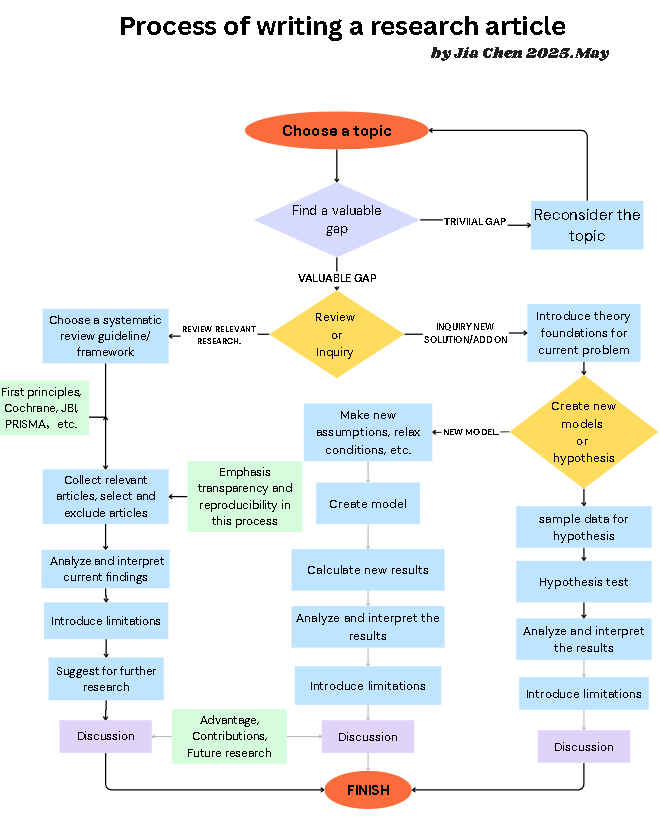
Annotation: Flowchart for Writing Research Article
This annotation summarizes a key non-assignment deliverable: a periodical learning review after completing Dr. Bret Staudt Willet’s course, Learning Performance Research.
This flow chart outlines a simplified, systematic process for preparing and writing academic papers and research proposals. It itemizes the critical phases of research preparation, including defining a substantial problem, selecting foundational theory, reviewing relevant literature, developing theoretical or conceptual models, planning data collection, and scrutinizing current progress and limitations.
I independently designed this flowchart to provide a flexible, simplified roadmap for guiding research preparation across various disciplines, rather than limiting itself to a specific topic.
Through the development of this flowchart, I demonstrate my competency in generating appropriate analysis strategies and activities, identifying the scope and sequence for research, using technology tools in the design process, and developing instructional materials through flowcharting.
Tools: Canva
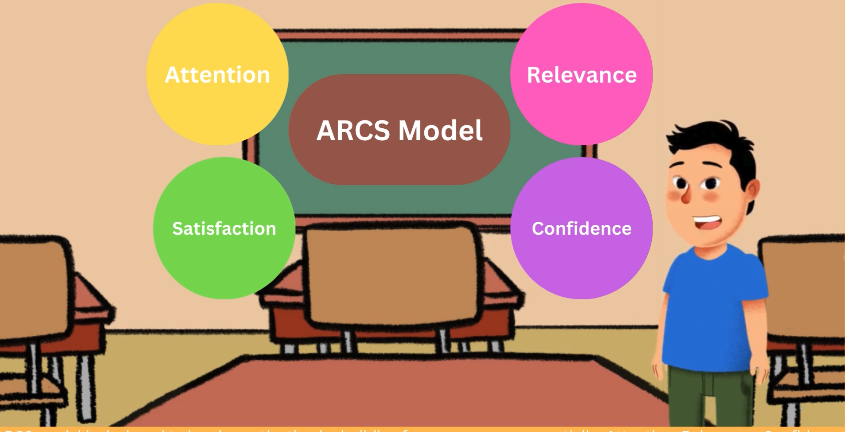
Annotation: Universal Design Short Video for ARCS Model
This annotation summarizes a media assignment completed independently for Dr. Kerry Burner’s course, Theory of Learning and Cognition, during the first semester of the ISLT master’s program.
This project involved the complete production of an instructional short video. I designed and prepared all elements, including selecting and designing visual assets, writing the script, recording the narration, and completing the final editing process.
This project demonstrates my competency in applying visual design principles appropriately, developing instructional materials using a variety of media, selecting suitable technology and media for specific learning outcomes, and using technology effectively for professional communication.
Tools: Animize, Audacity, Canva, iMovie
Annotation: Interactive Instruction
This annotation summarizes a major assignment completed independently for Dr. Allan Jeong’s course, Technology and Design, during the 2025 summer semester.
For this assignment, I chose the morphological and tense differences between Chinese and English grammar as the instructional topic. Applying instructional design principles, I created an interactive instructional module. I was responsible for the entire production workflow, which included independently selecting and designing images using Canva and ChatGPT, Writing the instructional script, generating AI-narration using Murf, integrating all these elements into an interactive instruction file in PowerPoint.
This project demonstrates my competency in applying interaction design principles, developing instructional materials using a variety of media, selecting suitable technology and media for specific learning outcomes, and using technology effectively for professional communication.

Tools: Audacity, Canva, ChatGPT, PowerPoint, Murf
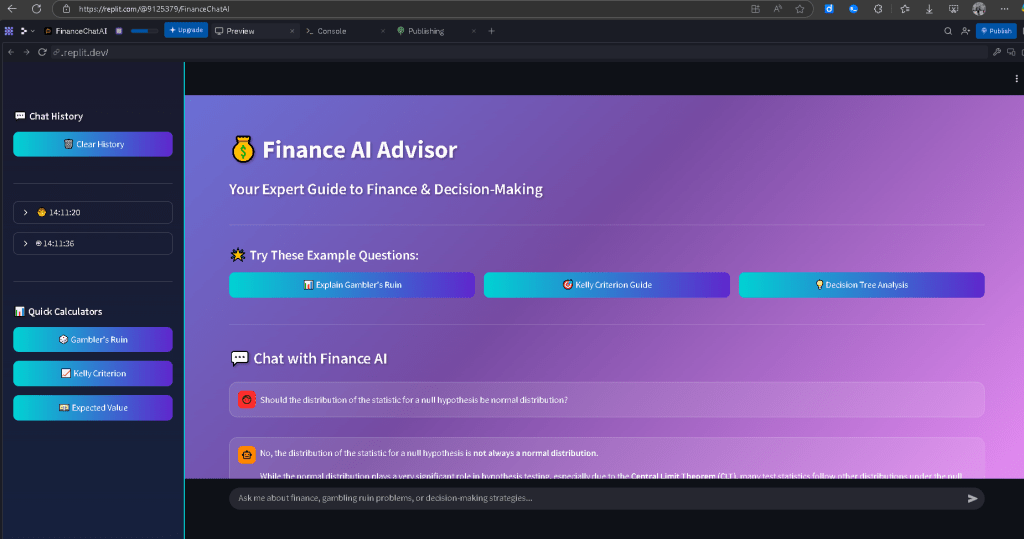
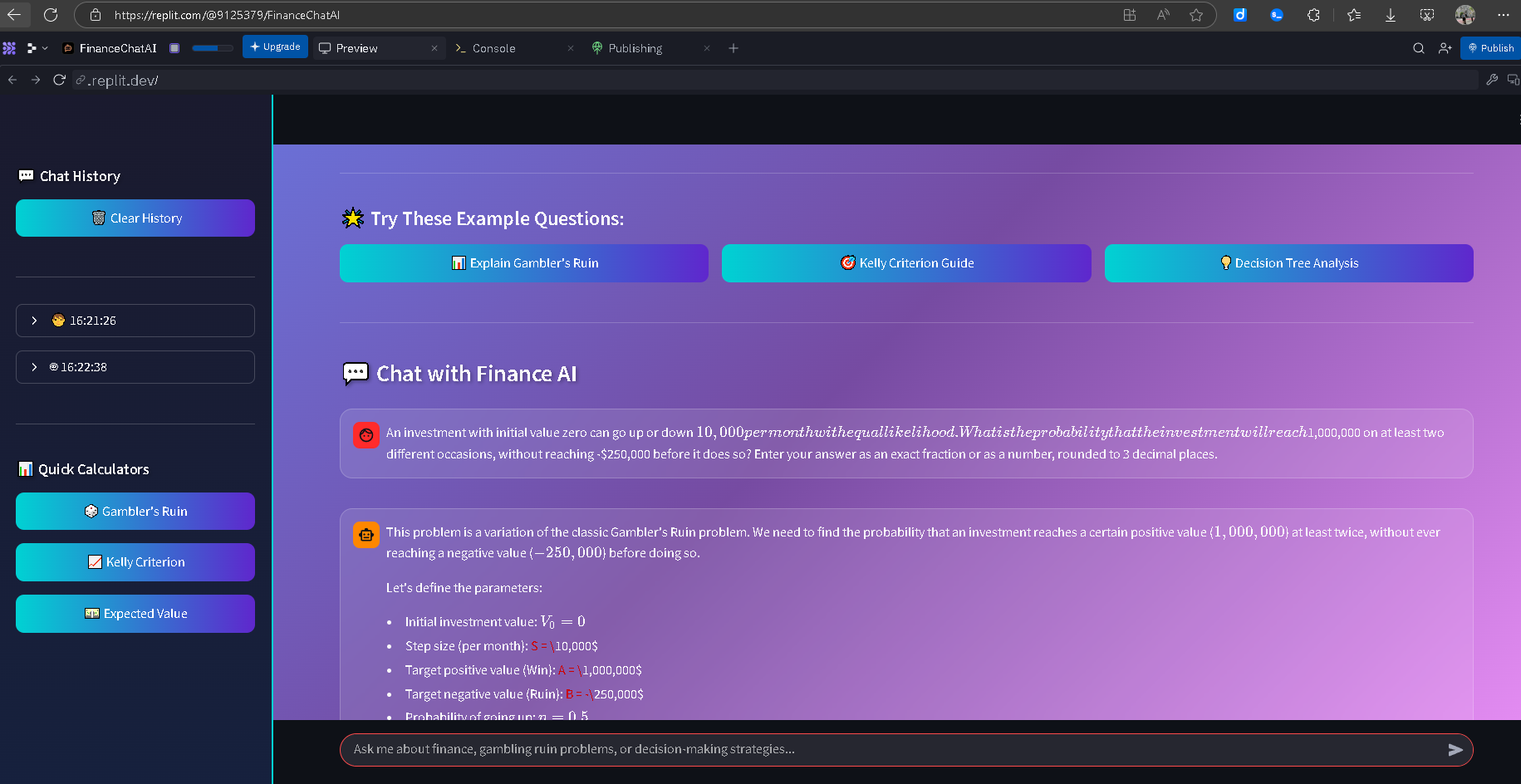
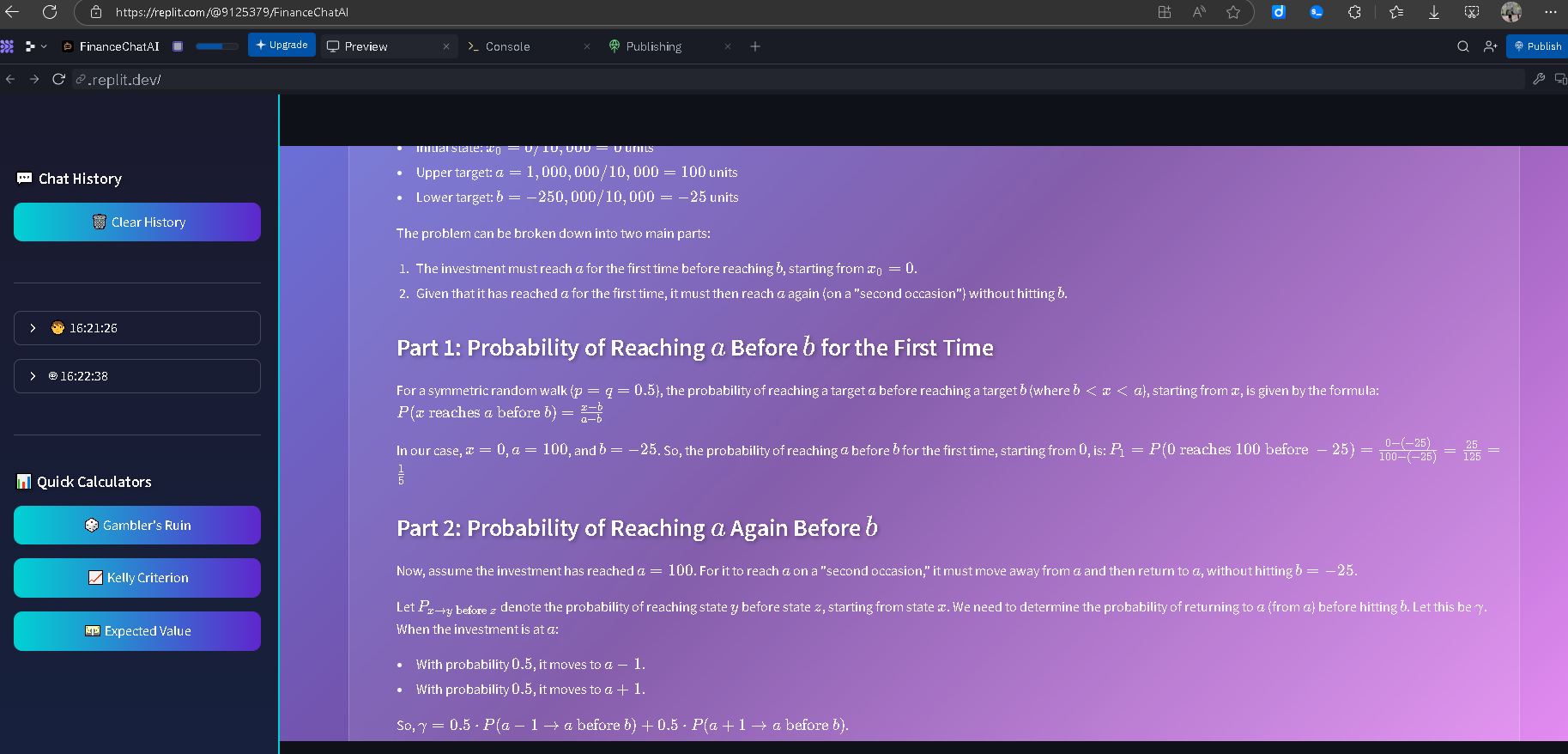
Vibe Coding Prototype: Creating an AI Chatbot on Replit
This is an outcome after learning of my group assignment “Instruction for create an AI Chatbot by replit” in the Fall 2025 semester for Dr. Songhee Han’s course, Trends and Issues in Instructional Design.
I learned how to build AI based applications using vibe coding in our group assignment. I built this vibe coding application independently after the completion Inspired by that group project. I would like to thank Dr. Damilare for providing the initial idea of exploring vibe coding for a chatbot.
In this practice, I used Replit as the vibe coding tool. By embedding Gemini via API, I created a prototype chatbot that functions as an AI advisor, helping learners study fundamental finance theories and concepts.
This practice demonstrates my skills in developing instructional materials using a variety of media, selecting suitable technology and media for specific learning outcomes, and using technology effectively for professional communication..
Tools: Gemini, Replit
 Jia’s personal website